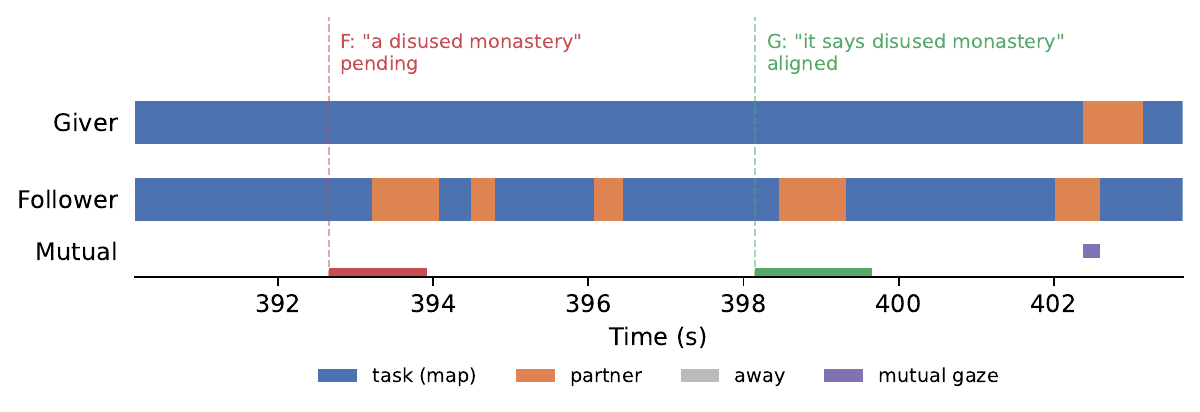
Across two collaborative tasks, more task-focused and less variable gaze is associated with understanding, offering a modest, context-dependent cue to common ground.
BibTeX
@misc{li2026gaze,title={Gaze as Evidence for Common Grounding: A Cross-Corpus Analysis of MapTask and MUNDEX},author={Li, Nan and Gatt, Albert and Poesio, Massimo},day={16},month=sep,year={2026},eprint={2609.18011},archiveprefix={arXiv},primaryclass={cs.CL},url={https://arxiv.org/abs/2609.18011},note={Accepted to the MINT Workshop at EMNLP 2026},}
Acquire, Repair, Preserve: A Diagnosis-Guided Post-Training Recipe for Small-Model Dialogue Game Agents
Nan Li
arXiv preprint , Aug 2026
Accepted to the LM Playschool Workshop at EMNLP 2026
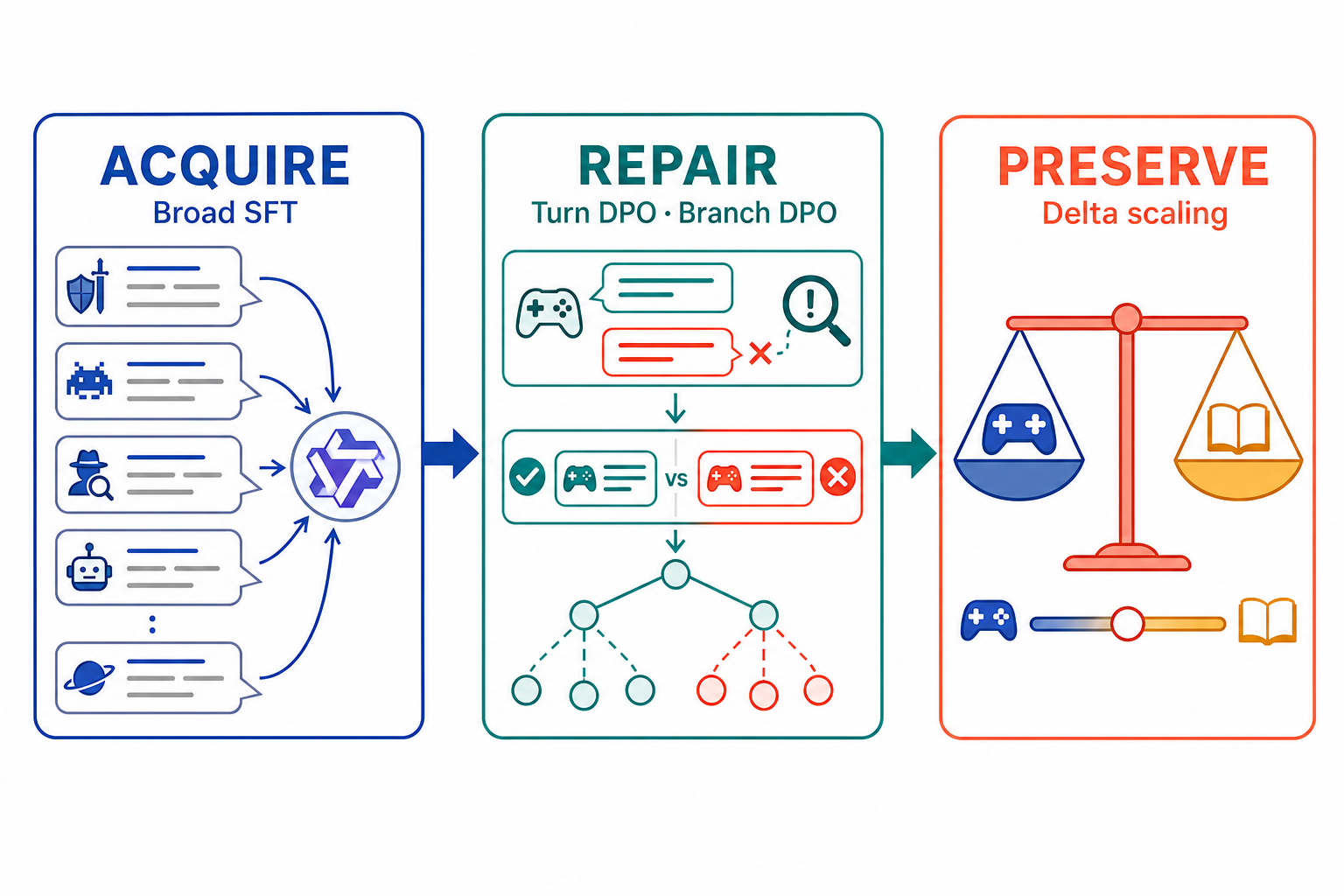
Broad supervised training drives most improvements in a 2B dialogue-game agent, while targeted error correction complements it; general capabilities are largely preserved, but transfer to unrelated games remains limited.
BibTeX
@misc{li2026acquire,title={Acquire, Repair, Preserve: A Diagnosis-Guided Post-Training Recipe for Small-Model Dialogue Game Agents},author={Li, Nan},day={28},month=aug,year={2026},eprint={2608.28458},archiveprefix={arXiv},primaryclass={cs.CL},url={https://arxiv.org/abs/2608.28458},note={Accepted to the LM Playschool Workshop at EMNLP 2026},}
Seeing Is Not Sharing: Some Vision-Language Models Overestimate Common Ground in Asymmetric DialogueOral
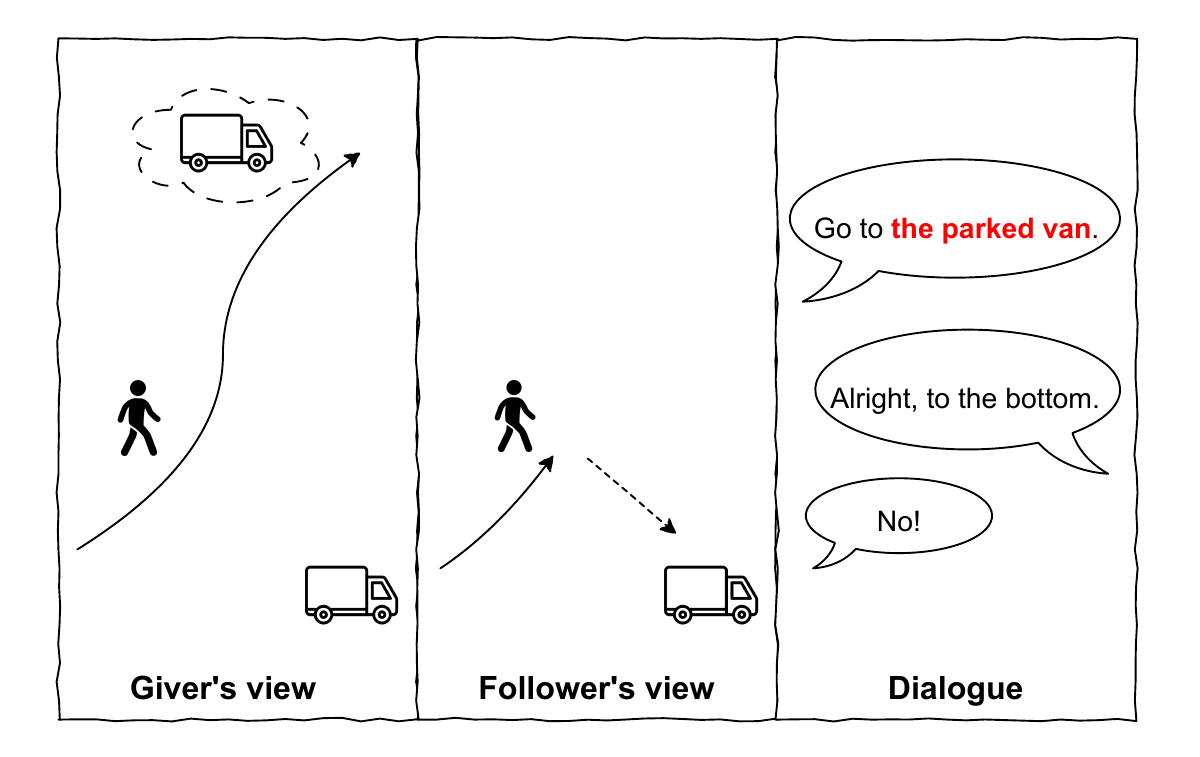
Some VLMs over-predict shared understanding when given map content as images or text. They rely on static map cues rather than tracking how grounding develops through dialogue, confusing what could be shared with what has actually been established as common ground.
BibTeX
@inproceedings{li2026seeing,title={Seeing Is Not Sharing: Some Vision-Language Models Overestimate Common Ground in Asymmetric Dialogue},author={Li, Nan and Gatt, Albert and Poesio, Massimo},booktitle={Proceedings of the 27th Annual Meeting of the Special Interest Group on Discourse and Dialogue (SIGDIAL)},pages={694--710},month=aug,year={2026},address={Atlanta, Georgia, USA},publisher={Association for Computational Linguistics},}
Grounded Misunderstandings in Asymmetric Dialogue: A Perspectivist Annotation Scheme for MapTaskOral
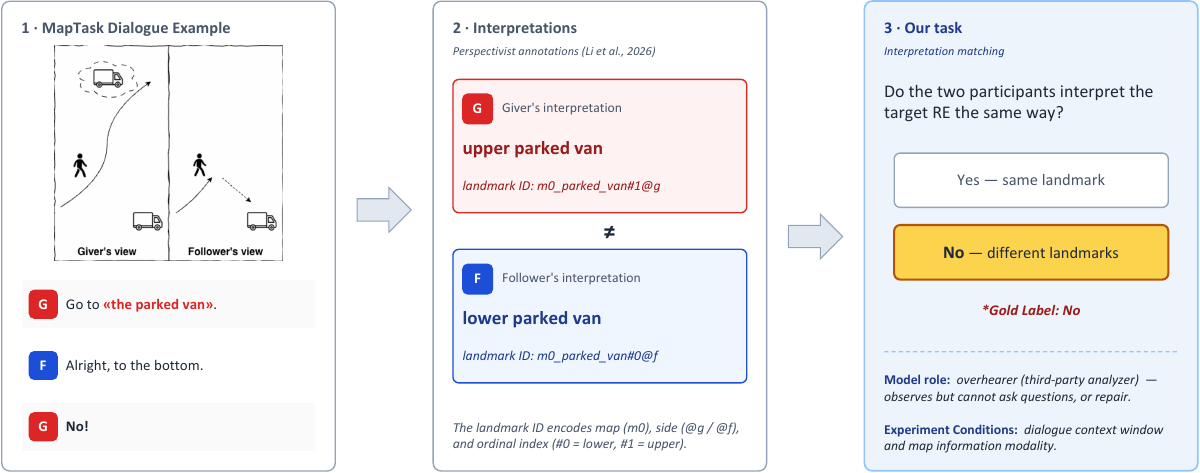
A perspectivist annotation scheme for MapTask tracks each participant’s interpretation of references, revealing how apparent agreement can conceal mismatches in what they mean.
BibTeX
@inproceedings{li2026grounded,title={Grounded Misunderstandings in Asymmetric Dialogue: A Perspectivist Annotation Scheme for MapTask},author={Li, Nan and Gatt, Albert and Poesio, Massimo},booktitle={Proceedings of the Fifteenth Language Resources and Evaluation Conference (LREC)},pages={4988--5001},month=may,year={2026},address={Palma, Mallorca, Spain},publisher={European Language Resources Association (ELRA)},doi={10.63317/59anbt78wyj7},}
2025
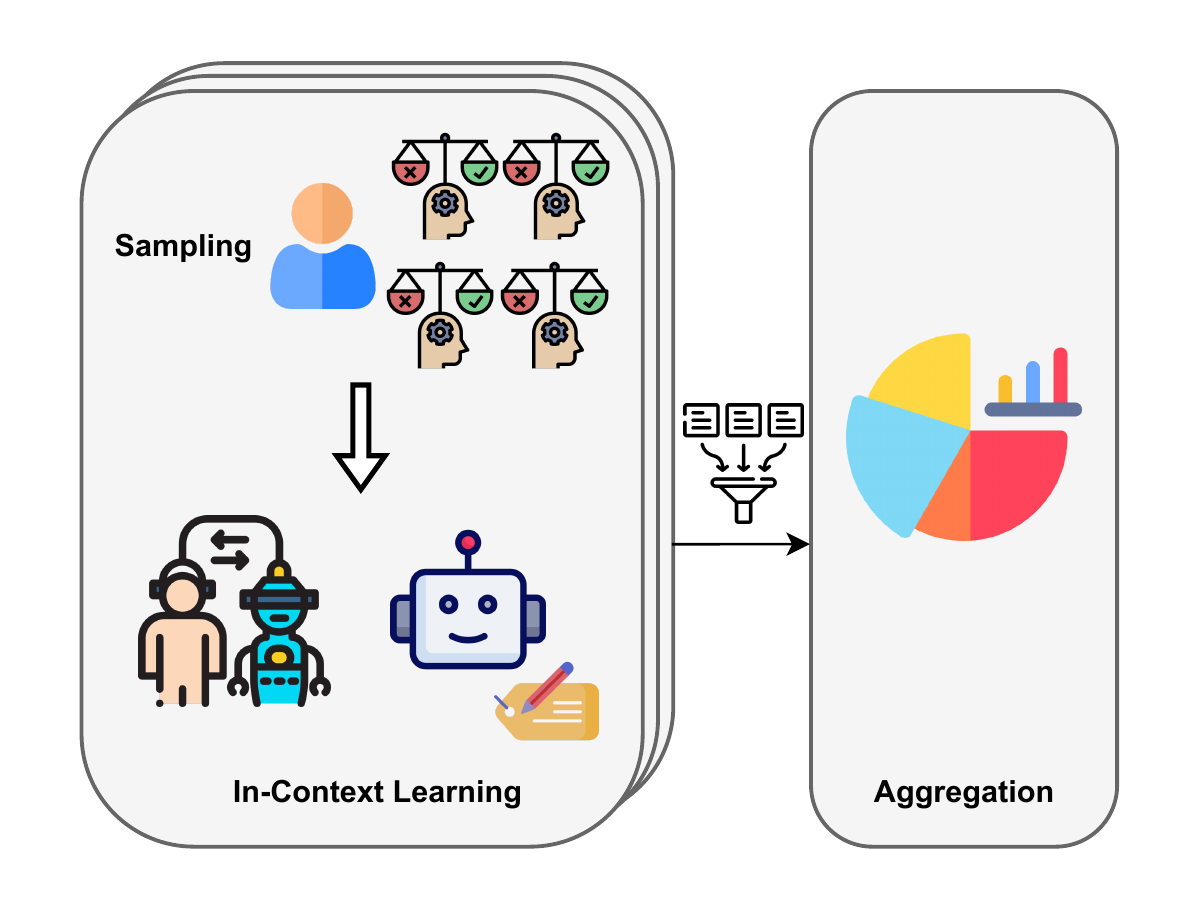
DeMeVa at LeWiDi-2025: Modeling Perspectives with In-Context Learning and Label Distribution Learning
In-context learning with LLMs can predict individual annotators’ labels, and pooling these predictions yields competitive soft labels. Label distribution learning with RoBERTa also shows promise for modeling disagreement.
BibTeX
@inproceedings{ignatev2025demeva,title={DeMeVa at LeWiDi-2025: Modeling Perspectives with In-Context Learning and Label Distribution Learning},author={Ignatev, Daniil and Li, Nan and Wong, Hugh Mee and Dang, Anh and Yaschuk, Shane Kaszefski},booktitle={Proceedings of the 4th Workshop on Perspectivist Approaches to NLP (NLPerspectives)},pages={171--181},month=nov,year={2025},address={Suzhou, China},publisher={Association for Computational Linguistics},doi={10.18653/v1/2025.nlperspectives-1.15},}
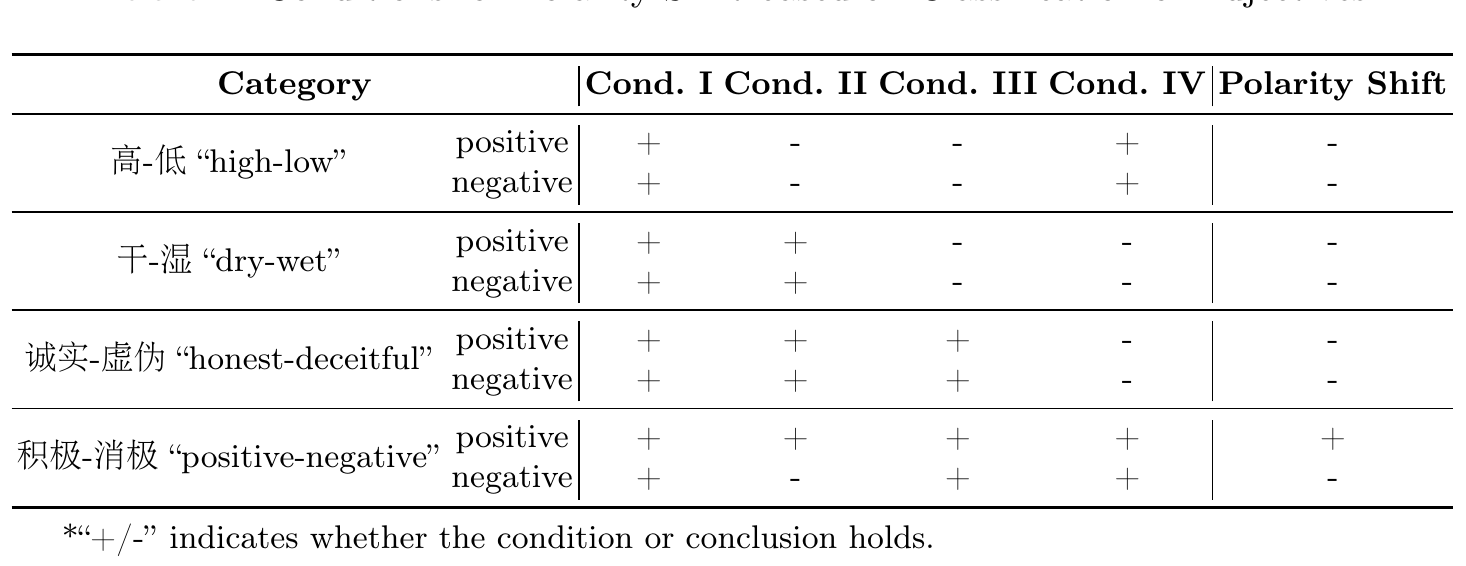
Polarity Shift in the “bù ‘not’ + Adj./Verb” ConstructionOral
In Chinese, “不 + adjective/verb” can express the meaning of an antonym rather than simple negation; we identify four conditions governing this polarity shift.
BibTeX
@inproceedings{li2024polarity,title={Polarity Shift in the ``b\`u `not' + Adj./Verb'' Construction},author={Li, Nan and Zhan, Weidong},booktitle={Chinese Lexical Semantics (CLSW)},series={Lecture Notes in Artificial Intelligence},volume={15552},pages={340--354},year={2025},publisher={Springer Nature Singapore},doi={10.1007/978-981-96-3509-2_25},}
2024
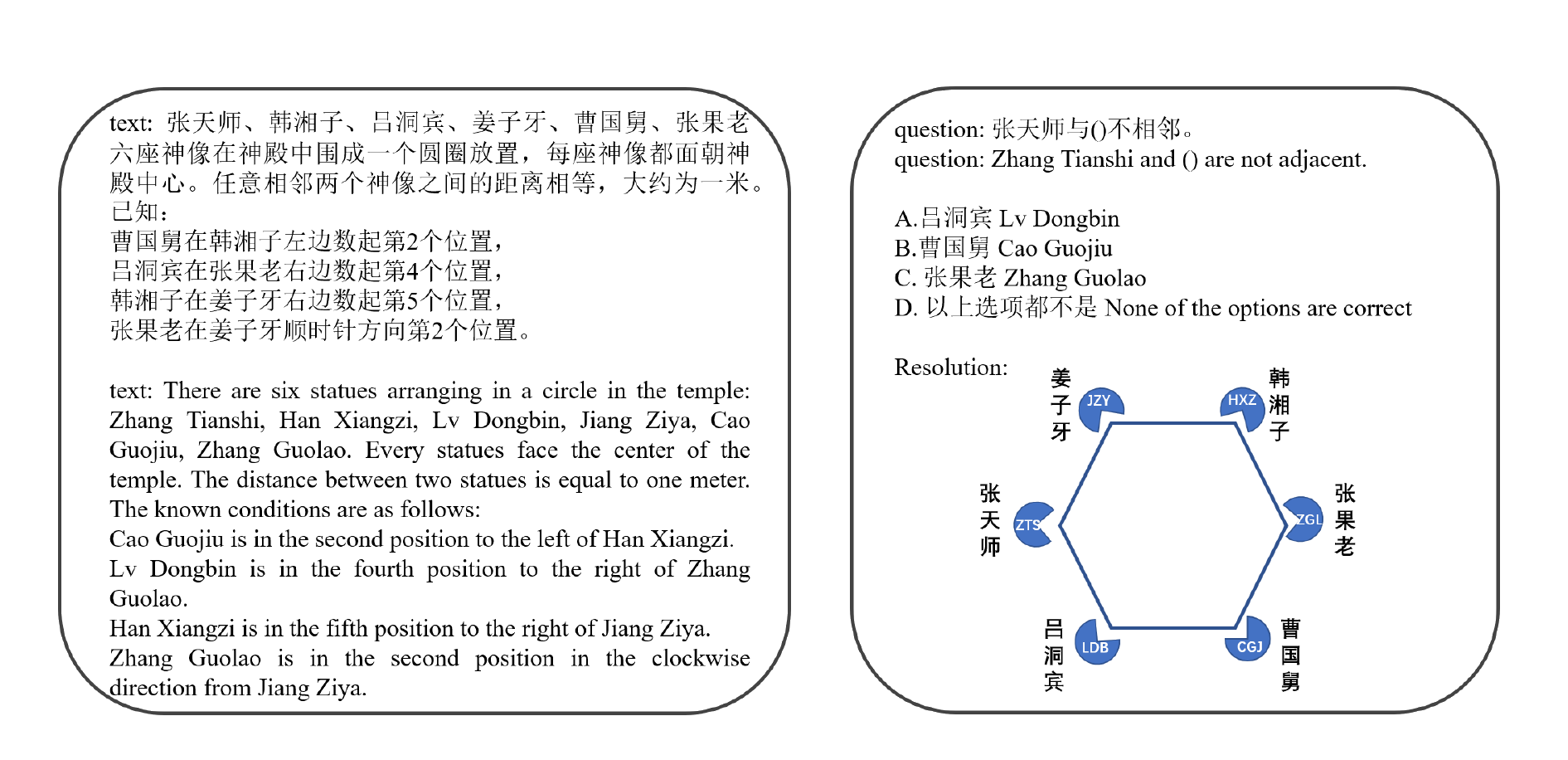
Overview of CCL24-Eval Task 3: The Fourth Evaluation on Chinese Spatial Cognition
Liming Xiao, Nan Hu, Weidong Zhan, Yuhang Qin, Sirui Deng, Chunhui Sun, Qixu Cai, and Nan Li
In Proceedings of the 23rd Chinese National Conference on Computational Linguistics (Volume 3: Evaluations), Jul 2024
A five-task Chinese spatial understanding benchmark exposes substantial room for improvement in LLMs, with the best participating system achieving 60.24% accuracy.
BibTeX
@inproceedings{xiao2024fourth,title={Overview of CCL24-Eval Task 3: The Fourth Evaluation on Chinese Spatial Cognition},author={Xiao, Liming and Hu, Nan and Zhan, Weidong and Qin, Yuhang and Deng, Sirui and Sun, Chunhui and Cai, Qixu and Li, Nan},booktitle={Proceedings of the 23rd Chinese National Conference on Computational Linguistics (Volume 3: Evaluations)},pages={122--134},month=jul,year={2024},address={Taiyuan, China},publisher={Chinese Information Processing Society of China},}
2023
Overview of CCL23-Eval Task 4: The 3rd Chinese Spatial Cognition Evaluation
Liming Xiao, Weidong Zhan, Zhifang Sui, Yuhang Qin, Chunhui Sun, Dan Xing, Nan Li, Fangwei Zhu, and Peiyi Wang
In Proceedings of the 22nd Chinese National Conference on Computational Linguistics (Volume 3: Evaluations), Aug 2023
SpaCE2023 adds scene-equivalence judgments to Chinese spatial understanding evaluation, alongside anomaly detection and spatial relation labeling, and examines ChatGPT’s performance on these tasks.
BibTeX
@inproceedings{xiao2023ccl23,title={Overview of CCL23-Eval Task 4: The 3rd Chinese Spatial Cognition Evaluation},author={Xiao, Liming and Zhan, Weidong and Sui, Zhifang and Qin, Yuhang and Sun, Chunhui and Xing, Dan and Li, Nan and Zhu, Fangwei and Wang, Peiyi},booktitle={Proceedings of the 22nd Chinese National Conference on Computational Linguistics (Volume 3: Evaluations)},pages={150--158},month=aug,year={2023},address={Harbin, China},publisher={Chinese Information Processing Society of China},}
A Quality Assessment Report of the Chinese Spatial Cognition Evaluation Benchmark
Liming Xiao, Chunhui Sun, Weidong Zhan, Dan Xing, Nan Li, Chengwen Wang, and Fangwei Zhu
In Proceedings of the 22nd Chinese National Conference on Computational Linguistics, Aug 2023
We document how SpaCE2022 was constructed and quality-checked, identifying substantial label imbalance and low annotator agreement on spatial correctness and anomaly attribution as priorities for future benchmark revisions.
BibTeX
@inproceedings{xiao2023space2022,title={A Quality Assessment Report of the Chinese Spatial Cognition Evaluation Benchmark},author={Xiao, Liming and Sun, Chunhui and Zhan, Weidong and Xing, Dan and Li, Nan and Wang, Chengwen and Zhu, Fangwei},booktitle={Proceedings of the 22nd Chinese National Conference on Computational Linguistics},pages={547--558},month=aug,year={2023},address={Harbin, China},publisher={Chinese Information Processing Society of China},}
2020
Acoustic Analysis of Single-word Tones and Two-word Changed Tones in Ganzhou Dialect
Our acoustic analysis establishes the tone values of single syllables and two-syllable tone sandhi in Ganzhou, a Southwestern Mandarin enclave. We also find that the checked tone (入声) survives only in connected speech and has merged with the departing tone (去声) in isolation.
BibTeX
@misc{li2020ganzhou,title={Acoustic Analysis of Single-word Tones and Two-word Changed Tones in Ganzhou Dialect},author={Li, Nan},year={2020},howpublished={ChinaXiv preprint},note={ChinaXiv:202011.00035},}
 DeMeVa at LeWiDi-2025: Modeling Perspectives with In-Context Learning and Label Distribution LearningIn Proceedings of the 4th Workshop on Perspectivist Approaches to NLP (NLPerspectives), Nov 2025
 Polarity Shift in the “bù ‘not’ + Adj./Verb” ConstructionOralIn Chinese Lexical Semantics (CLSW), 2025
 Overview of CCL24-Eval Task 3: The Fourth Evaluation on Chinese Spatial CognitionIn Proceedings of the 23rd Chinese National Conference on Computational Linguistics (Volume 3: Evaluations), Jul 2024
 Overview of CCL23-Eval Task 4: The 3rd Chinese Spatial Cognition EvaluationIn Proceedings of the 22nd Chinese National Conference on Computational Linguistics (Volume 3: Evaluations), Aug 2023
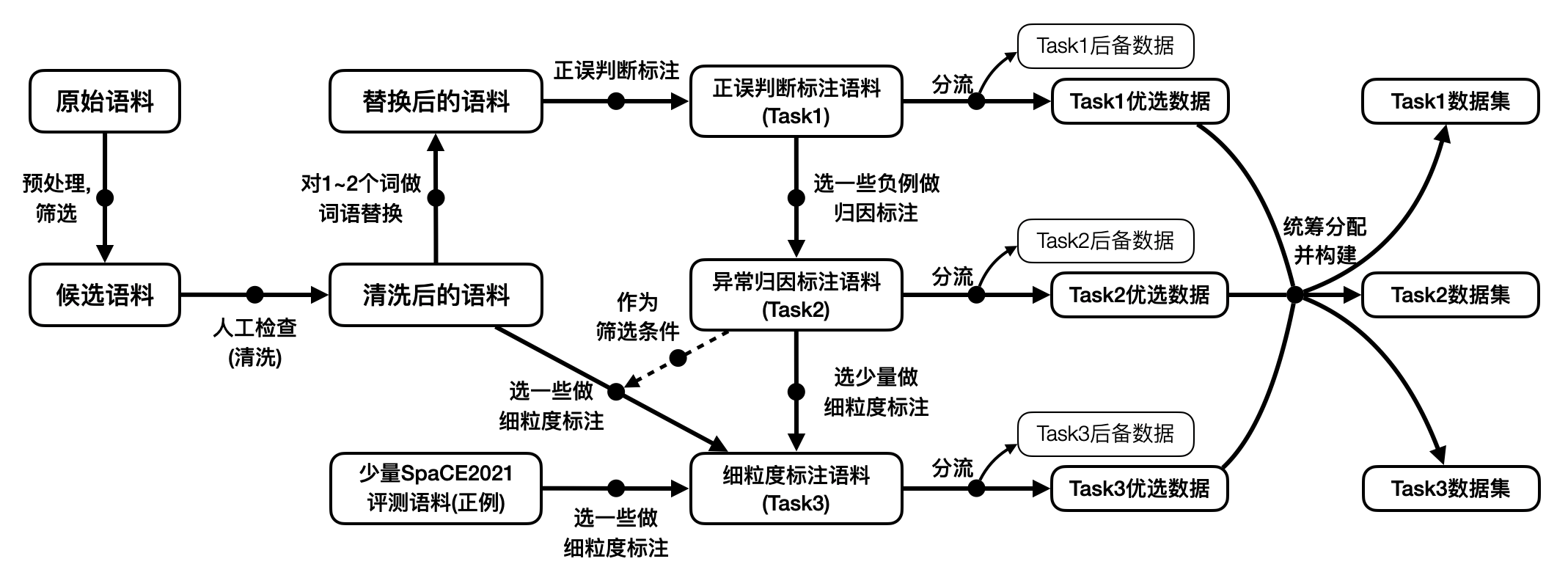 A Quality Assessment Report of the Chinese Spatial Cognition Evaluation BenchmarkIn Proceedings of the 22nd Chinese National Conference on Computational Linguistics, Aug 2023
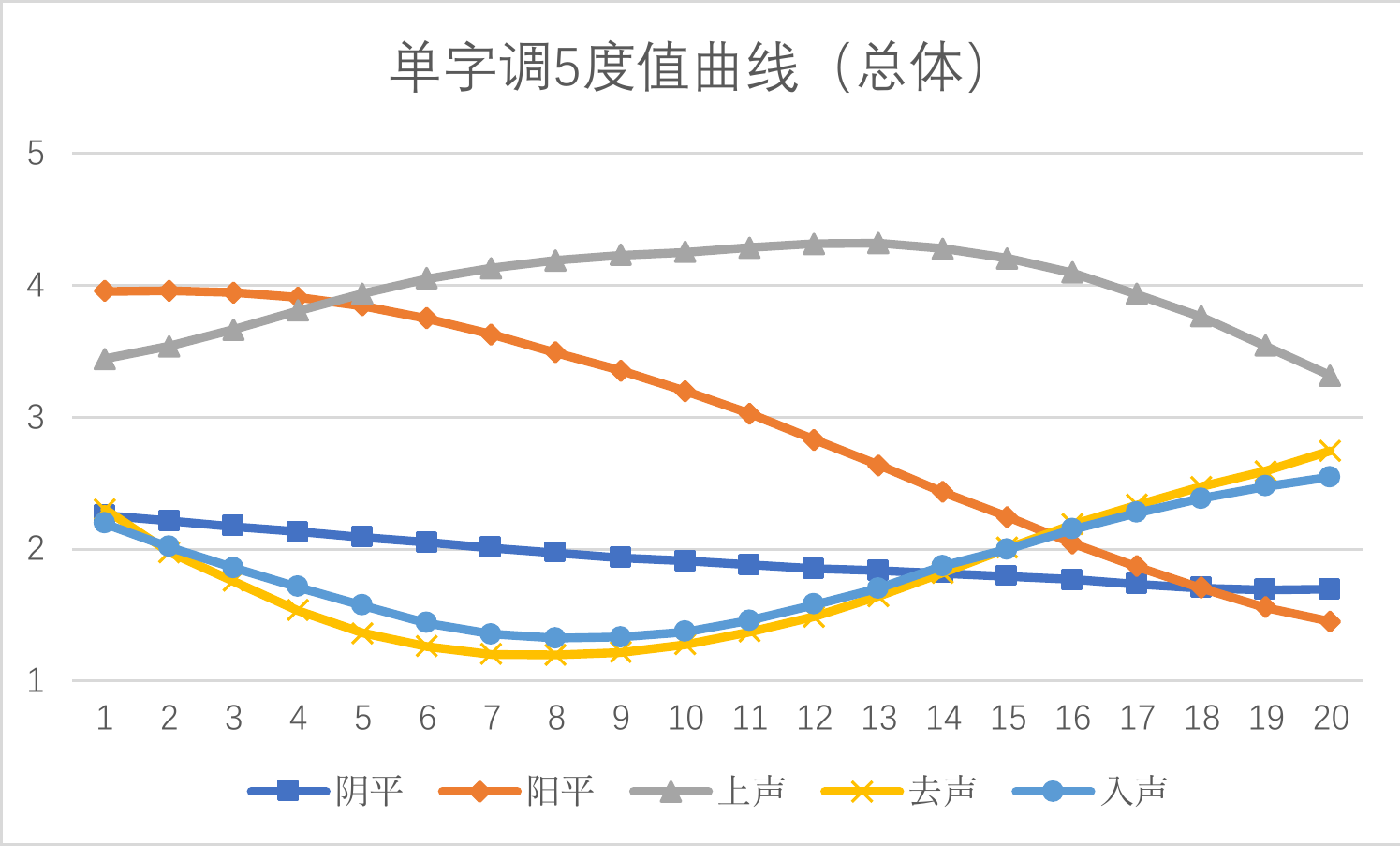 Acoustic Analysis of Single-word Tones and Two-word Changed Tones in Ganzhou Dialect2020ChinaXiv:202011.00035